

Views: 0 Author: Site Editor Publish Time: 2026-09-15 Origin: Site


The economic viability of processing Used Beverage Cans (UBC) relies entirely on maximizing payload weights and meeting strict smelter specifications. Processing loose aluminum cans without adequate compaction leads to light loads. This exponentially increases freight logistics and slashes operational margins. Meanwhile, inadequate baling equipment results in high maintenance downtime, wire breakage, and rejected bales at the mill due to improper density or contamination. Optimizing this process requires moving beyond basic compaction. Facilities must engineer a workflow that transforms loose scrap into dense, stackable, and compliant commodities. This guide breaks down the technical requirements for processing aluminum scrap. You will learn how to evaluate commercial equipment based on throughput and density metrics. We also cover the operational trade-offs of different baling systems. Implementing the right mechanical infrastructure ensures your facility maximizes payload efficiency while eliminating mill rejections.
Framing the end-goal before selecting equipment prevents costly operational bottlenecks. Mill specifications dictate baler requirements directly. Smelters operate strictly controlled furnaces. They require aluminum bales that melt predictably without excessive oxidation. Bales that are too loose break apart during handling. This creates massive surface area exposure, leading to high melt loss when the aluminum hits the furnace. Conversely, bales that are too dense trap moisture and contaminants inside the core. This trapped moisture turns into steam instantly upon hitting molten metal. The resulting steam expansion causes dangerous explosions inside the melting furnace. Therefore, your processing equipment must hit a very precise compaction sweet spot. You cannot simply crush the material as hard as possible. You must engineer the compaction force to meet the exact density requirements of your downstream buyers.
Success in UBC recycling hinges on hitting the industry standard density of 14 to 15 pounds per cubic foot. Hitting this metric ensures the aluminum melts efficiently at the smelter. It also dictates your shipping efficiency. Standard mill-ready bale sizes typically measure 30" x 40" x 48" or 30" x 60" x 45". These specific dimensions are not arbitrary. They allow operators to load bales side-by-side and double-stacked inside standard 53-foot dry van trailers.
Maximizing a trailer payload means hitting the legal weight limit of approximately 40,000 pounds per truck. If your bales lack density, the truck fills up with empty space before hitting the weight limit. You end up paying to ship air. Optimal bale weights range from 800 to 1,200 pounds. This weight range allows for safe forklift handling while maintaining structural integrity during transit.
| Bale Dimension (Inches) | Target Density (lbs/ft³) | Estimated Bale Weight (lbs) | Trailer Loading Configuration |
|---|---|---|---|
| 30 x 40 x 48 | 14 - 15 | 800 - 900 | Double stacked, side-by-side |
| 30 x 60 x 45 | 14 - 15 | 1,000 - 1,200 | Double stacked, side-by-side |
| 42 x 42 x 48 | 14 - 15 | 1,300 - 1,400 | Single stacked (requires flatbed) |
Residual liquids present a massive challenge in beverage can processing. Sugary sodas and acidic juices remain inside uncrushed cans. During compaction, this liquid violently expels under thousands of pounds of hydraulic pressure. If left unmanaged, these fluids degrade bale integrity. They also lower the price mills are willing to pay for your material. Furthermore, acidic liquids corrode standard steel baler floors rapidly. The pH levels of common soft drinks will eat through mild steel plates within months of continuous operation.
Modern equipment integrates fluid collection trays beneath the compaction chamber. These trays channel expelled liquids away from the machine. This prevents slip hazards on the facility floor. It also ensures environmental compliance by keeping contaminated runoff out of municipal drains. You must pipe this runoff into dedicated holding tanks for proper disposal.
Contamination control extends beyond liquids. Ferrous metal removal is an absolute necessity. A stray steel soup can mixed into an aluminum bale will trigger a load rejection at the mill. Integrating cross-belt magnets over the infeed conveyor automatically pulls ferrous materials out of the stream. This simple pre-processing step guarantees a pure aluminum yield.
Selecting the right machine architecture depends entirely on your daily volume. Vertical balers offer a smaller footprint and require less initial capital. Operators load material manually into the chamber. These machines suit low-volume feeder yards processing under one ton per hour. However, they require manual wire tying. This slows down production significantly. An operator must stop loading, manually thread wires through the chamber slots, tie the knots, and eject the bale.
Horizontal systems provide high throughput and continuous operation. They require a larger facility footprint but automate the entire compaction cycle. Commercial recycling facilities rely on horizontal configurations. They handle massive volumes without bottlenecking the sorting line. A robust aluminum can baler in a horizontal setup runs continuously, ejecting finished bales seamlessly.
| System Type | Throughput Capacity | Loading Method | Tying Mechanism | Footprint Requirement |
|---|---|---|---|---|
| Vertical Baler | Under 1 Ton/Hour | Manual / Forklift | Manual Tie | Minimal (approx. 100 sq ft) |
| Horizontal Baler | 1 to 15+ Tons/Hour | Automated Conveyor | Auto-Tie System | Large (approx. 500+ sq ft) |
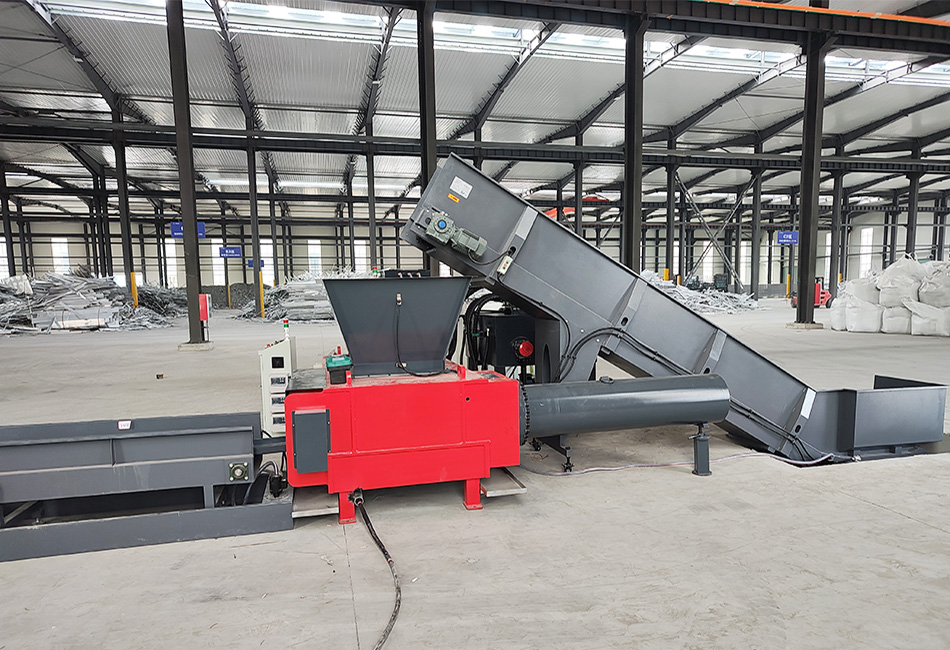
Feeding material efficiently is just as important as the compaction itself. Manual loading simply cannot keep up with commercial processing demands. Conveyor-to-hopper feeding systems automate the material flow. A pit conveyor or slider bed conveyor moves loose cans up into a large receiving hopper above the compaction chamber. Steel belt conveyors offer the best durability for this application, as rubber belts tear easily when exposed to sharp aluminum edges.
Hopper design plays a critical role in preventing material bridging. Bridging occurs when cans interlock and form an arch, blocking material from falling into the chamber. A well-engineered hopper feed aluminum baler features flared walls or mechanical agitators. These features break up clogs before they cause downtime. Integrating the hopper feed with pre-conditioning equipment, such as can flatteners, maximizes infeed density and speeds up cycle times. Photo-eye sensors mounted inside the hopper automatically start and stop the conveyor based on material levels, preventing overfilling.
Horizontal balers generally fall into two categories: single-ram and two-ram systems. Each serves a distinct operational purpose. Single-ram machines extrude the bale through a tensioned channel. The friction of the material against the channel walls creates the compaction resistance. These machines are highly cost-effective for dedicated aluminum lines. If your facility only processes cans, a single-ram system provides consistent material flow.
Conversely, a two-ram aluminum scrap baler is necessary for multi-material facilities. The dual-ram design offers superior compaction force. The primary ram pushes the material against a solid steel door, achieving maximum density. Then, a secondary ram pushes the finished bale out through the tying tier. This creates perfectly squared bales with clean edges, maximizing stackability inside shipping containers.
The hydraulic power unit acts as the heart of the machine. Evaluating system operating pressure (PSI) and cylinder bore size ensures adequate compaction force. A larger cylinder bore operating at high pressure delivers the crushing force needed to hit the 14 lbs/ft³ density mark. You must look for systems operating between 2,500 and 3,000 PSI with at least an 8-inch to 10-inch main cylinder bore.
High pressure generates significant heat. Hydraulic oil cooling systems are mandatory for continuous shifts. You must choose between air-to-oil or water-to-oil coolers. Water-to-oil coolers provide superior heat dissipation but require a dedicated water line and chiller system. Maintaining fluid viscosity prevents the machine from slowing down as the oil heats up. Analyzing dry cycle times helps translate raw mechanical speed into actual tons-per-hour (TPH) throughput. A faster ram stroke means more cans processed per shift. Look for dry cycle times under 20 seconds for optimal efficiency.
As the ram moves forward, it must shear off any aluminum hanging over the edge of the charge box. Crushed aluminum is notoriously difficult to cut cleanly. It tends to fold and wedge between the ram and the frame. You need heavy-duty, serrated, or replaceable shear blades to cut through overlapping scrap without jamming. Tool steel blades offer the best longevity. You must maintain tight tolerances between the stationary and moving blades, often requiring regular shimming by your maintenance team.
When jams inevitably occur, operator safety and speed are paramount. Evaluate the access points on the machine. Safe, oversized access doors allow maintenance teams to clear jams rapidly. A robust used beverage can baler will feature hydraulic relief valves and reversible ram functions to assist in dislodging stubborn material.
Aluminum has a high memory factor. It wants to expand immediately after compaction. The tying system must secure the bale before this expansion compromises the shape. Automated wire tie systems are standard on horizontal machines. You must compare galvanized wire against black annealed wire. Galvanized wire resists rust, making it ideal for outdoor bale storage. Typically, 11-gauge or 12-gauge wire provides the necessary tensile strength to hold dense aluminum bales.
Evaluate the reliability of the inserter and twister mechanisms. The knotter gears must pull the wire tight and twist it securely. A failed knot results in a bale explosion during transit. This creates a massive safety hazard and requires complete reprocessing of the loose material. Regular cleaning of the knotter gears using compressed air prevents aluminum dust buildup from fouling the tying cycle.
Crushed aluminum acts like sandpaper against steel surfaces. The abrasive nature of the material destroys standard mild steel floors quickly. A high-quality UBC baler requires AR (Abrasion Resistant) steel floor and side liners. AR400 or AR500 steel plates withstand the constant friction of sliding aluminum. Some manufacturers use Hardox steel for even greater wear resistance.
Evaluate how these liners attach to the machine frame. Bolt-on liners offer superior maintenance efficiency. When a liner eventually wears out, technicians can unbolt and replace it in hours. Weld-on liners require extensive grinding, cutting, and re-welding, causing days of operational downtime. Floor grooving is another critical feature. Grooved floors allow the wire tie needles to pass through the chamber without catching on stray aluminum scrap.
Modern programmable logic controllers (PLCs) govern the entire machine cycle. The PLC optimizes ram strokes, manages hydraulic pressure spikes, and times the tying cycle perfectly. Advanced control panels feature touchscreen interfaces. These screens display real-time operational data, hydraulic temperatures, and bale counts. Operators can adjust bale length and compaction pressure directly from the screen.
Remote diagnostic capabilities provide immense value. When a sensor faults, the PLC can transmit the error code directly to the manufacturer's support team via a secure VPN connection. This allows technicians to troubleshoot issues over the internet. It eliminates the need for a physical service call for minor software or sensor resets. Transducer sensors monitor hydraulic pressure continuously, alerting operators to potential pump failures before they occur.
Installing heavy recycling machinery requires meticulous site preparation. You must account for the total operational footprint. This includes the baler itself, the infeed conveyor, magnetic separators, wire payoff stands, and the bale staging area. Forklifts require adequate turning radiuses to remove bales safely from the ejection chute.
Electrical infrastructure often presents a hidden bottleneck. These machines require robust 3-phase power. Verify your facility can handle the massive amperage draw required by 50 HP to 100+ HP electric motors. Upgrading facility electrical panels causes significant project delays if not identified early. Additionally, the concrete pad must withstand the static weight and the dynamic vibration of continuous compaction. A minimum of an 8-inch reinforced concrete pad is typically required to anchor the machine securely.
Heavy hydraulic machinery presents severe crush and amputation hazards. Mitigating the risk of operator injury requires strict adherence to safety protocols. Proper lockout/tagout (LOTO) procedures must be enforced during all maintenance and jam clearance activities. Operators must never enter the charge box without physically disconnecting the main power source and bleeding off hydraulic pressure.
Ensure the equipment and the final installation meet ANSI Z245.5 safety standards for baling equipment. Evaluate the safety interlocks on all access doors. If an access door opens, the machine must immediately kill hydraulic pressure. Trapped key interlock systems provide the highest level of security, forcing operators to remove a physical key from the control panel to unlock the chamber doors. Comprehensive operator training prevents accidents and extends the lifespan of the equipment through proper daily use.
Your relationship with the equipment builder dictates your long-term success. A machine is only as reliable as the parts network supporting it. Assess the manufacturer's domestic parts inventory. If a proprietary hydraulic cylinder seal fails, waiting weeks for overseas shipping halts your production entirely. You need a partner who stocks critical wear parts locally.
Evaluate the technical support availability and the service technician network of the aluminum can baler manufacturer. Phone support should be accessible and staffed by engineers, not just dispatchers. Scrutinize the warranty details carefully. Distinguish between structural coverage, hydraulic component coverage, and electrical parts coverage. A strong structural warranty indicates confidence in the frame's welding and engineering.
A: The industry standard density for aluminum cans is between 14 and 15 pounds per cubic foot. Hitting this specific metric ensures the material melts efficiently at the smelter without trapping dangerous moisture. It also allows operators to maximize shipping payloads, easily reaching the 40,000-pound legal limit on standard 53-foot dry van trailers.
A: Using a standard cardboard baler for aluminum is highly discouraged. Cardboard balers lack the abrasion-resistant steel liners required to withstand sharp aluminum edges. They also typically lack the necessary hydraulic cylinder force to achieve the strict 14 lbs/ft³ density required by aluminum smelters, which frequently leads to rejected loads.
A: Throughput varies heavily based on the machine's cylinder size and hydraulic pump capacity. Small horizontal systems process 1 to 3 tons per hour. Large, high-capacity two-ram systems integrated with proper infeed conveyors can process upwards of 10 to 15 tons of aluminum scrap per hour.
A: A single-ram machine uses one cylinder to compact and extrude the material through a tensioned channel. A two-ram machine uses a primary cylinder to crush the material against a solid steel wall, and a secondary cylinder to eject and tie the bale. Two-ram systems provide denser, squarer bales.
A: The most effective method is installing a cross-belt magnetic separator over your infeed conveyor. As the mixed cans travel toward the hopper, the strong magnet automatically pulls ferrous steel cans out of the stream and drops them into a separate bin. This ensures a pure aluminum yield.
A: Preventing bale explosion requires hitting the correct compaction density and using a reliable automated tying system. Ensure your machine uses high-quality galvanized or annealed wire. The knotter system must be regularly maintained to ensure tight, secure twists that resist the natural expansion memory of crushed aluminum.
A: Shear blades require regular inspection for dullness and chipping. Because aluminum is highly abrasive, blades wear down and cause material jamming. Maintenance involves rotating the blades to expose a fresh cutting edge, adjusting the blade clearance tolerances, and replacing them entirely when all edges are worn.


 English

