

Views: 152 Author: Site Editor Publish Time: 2026-08-29 Origin: Site


High-value non-ferrous scrap—such as aluminum, copper, brass, and exotic alloys—loses significant profitability when stored, handled, or transported inefficiently due to low bulk density. Standard ferrous balers often fail to accommodate the unique malleability and "memory" (spring-back) of non-ferrous metals. This results in loose bales, excessive wear on machinery, structural failure during transport, and diminished recycling returns. When shipping loose non-ferrous scrap, you end up paying to transport empty air, creating severe logistical bottlenecks at processing facilities. Acting as the critical bridge between raw industrial waste and revenue generation, a specialized non ferrous metal baler maximizes payload and profitability. This guide breaks down the technical specifications, equipment variations, and operational trade-offs necessary to select the right machinery for high-value scrap recovery. We will examine hydraulic requirements, material handling differences, and facility integration steps to ensure your next equipment upgrade directly improves your bottom line.
Specialized non-ferrous balers utilize targeted hydraulic pressure and specific tying configurations to prevent material "spring-back," ensuring market-ready, mill-spec bale density.
Properly sorted non-ferrous metals—often utilizing advanced non-ferrous sensors prior to baling—can increase recycling returns by 20–40% compared to mixed scrap by optimizing freight weights and meeting strict buyer standards.
Equipment selection must balance daily throughput requirements with specific material characteristics (e.g., aluminum extrusions, copper wire, or exotic metal shavings).
Total Cost of Ownership (TCO) relies heavily on maintenance accessibility, the durability of wear parts (like shear blades), and the reliability of your scrap baler supplier.
Upgrading to specialized baling equipment directly supports corporate sustainability and ESG goals by enhancing operational efficiency and reducing the carbon footprint of scrap transportation.
Non-ferrous metals resist standard compression mechanics. Aluminum alloys, particularly 6000-series extrusions, and heavy copper wire possess high yield strengths relative to their weight. When a standard baler compresses these materials, the metal absorbs the kinetic energy rather than folding permanently. Once the hydraulic ram retracts, the scrap attempts to expand back to its original volume. We call this phenomenon material memory or spring-back.
Using inadequate equipment to process high-memory scrap poses severe operational risks. Bales that lack sufficient density or proper tying will experience structural failure during transit. Road vibrations and container handling cause loose bales to break apart. When mills receive broken or loose loads, they frequently reject the shipment outright. Rejected loads force yard managers to pay return freight costs, unload the container, and re-process the material. This destroys profit margins and wastes valuable labor hours. You need machinery specifically engineered to hold the material under pressure while the tying system secures the load.
Dense, uniform bales optimize shipping weights. Transportation regulations dictate strict weight limits for over-the-road trucks and ocean freight containers. A standard 40-foot shipping container can hold roughly 44,000 pounds of cargo. When shipping loose non-ferrous scrap, facilities hit the volumetric limit long before reaching the maximum weight limit. You might only fit 15,000 pounds of loose aluminum cans into a container. You end up paying full freight rates for a container that is mostly empty air.
Specialized baling equipment allows facilities to max out truck payloads consistently. Achieving mill-spec density reduces per-ton freight costs significantly. Presenting clean, high-density bales directly to foundries and mills also impacts gross revenue. Mills pay premium rates for dense bales because they melt more efficiently in reverberatory furnaces. High-density bales sink into the molten bath quickly, reducing oxidation and dross formation. This yields more usable metal per ton melted, allowing the mill to operate more efficiently and pass those premiums back to the scrap processor.
Efficient baling directly streamlines the recycling process. By maximizing the weight of every outbound shipment, facilities reduce the total number of freight trips required to move their material. Fewer trucks on the road immediately lower overall greenhouse gas emissions and reduce diesel fuel consumption. If you process 1,000 tons of aluminum per month, doubling your payload per truck cuts your outbound freight traffic in half.
Verifiable recycling efficiency metrics appeal to downstream manufacturing partners. Modern foundries and manufacturers focus heavily on sustainable supply chains. They require their scrap suppliers to demonstrate Environmental, Social, and Governance (ESG) compliance. Utilizing specialized baling equipment proves that a facility minimizes its carbon footprint during the scrap preparation and transportation phases. It shows a commitment to operational efficiency that aligns with the sustainability targets of major industrial buyers.
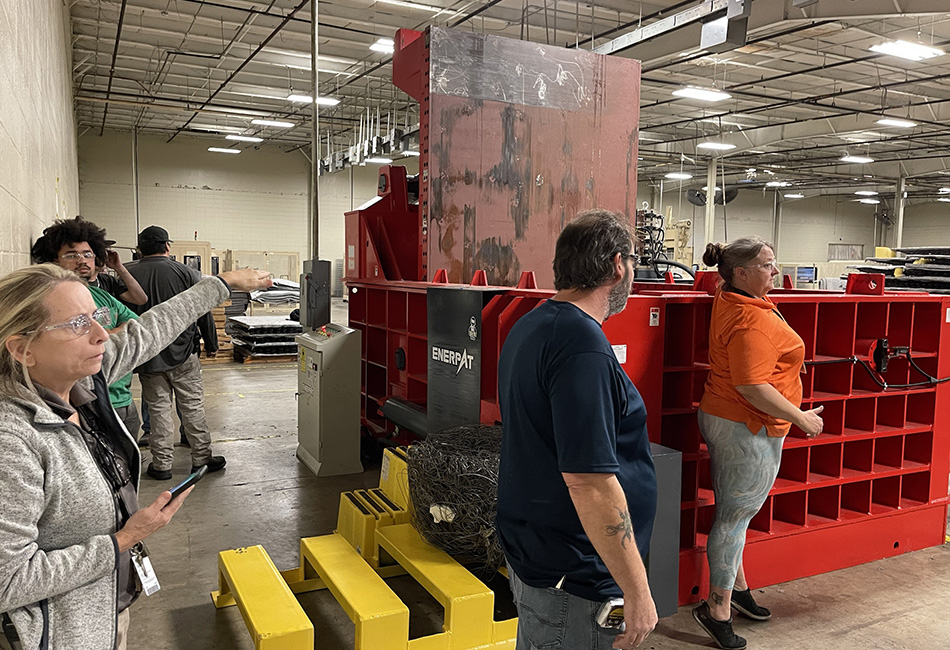
Single-ram balers suit smaller facilities with lower throughput requirements. These machines utilize one hydraulic cylinder to compress material against a closed heavy-duty door. They work well for operations processing highly uniform materials, such as a stamping plant that only generates one type of aluminum skeleton scrap. However, single-ram machines often require manual tying and struggle to contain materials with extreme spring-back. The operator must wait for the ram to fully compress the load, manually thread the wire, and tie off the bale before the door opens.
Two-ram balers represent the industry standard for high-volume, multi-material facilities. The primary ram gathers and compresses the scrap into the charge box. The secondary ram then pushes the compressed material at a 90-degree angle through an automated tying tier. This dual-action process provides superior density by compressing the material on two axes. It handles diverse scrap streams without manual intervention, making it ideal for high-memory non-ferrous metals.
Operational Comparison: Single-Ram vs. Two-Ram Balers | ||
Specification | Single-Ram Baler | Two-Ram Baler |
|---|---|---|
Compression Axes | Single axis (front to back) | Dual axis (front to back, then side to side) |
Tying Mechanism | Typically manual or semi-automated | Fully automated wire tier |
Throughput Capacity | 1 to 3 tons per hour | 5 to 20+ tons per hour |
Ideal Material | Uniform, low-memory scrap | Mixed, high-memory non-ferrous scrap |
Labor Requirement | High (requires dedicated operator) | Low (can operate continuously via conveyor) |
Handling aluminum requires specific mechanical features. Used beverage cans (UBCs), heavy extrusions, painted siding, and sheet scrap all behave differently under pressure. A dedicated aluminum scrap baler features specialized shear blades and charge box designs to handle these variations. The equipment must shear overhanging extrusions cleanly without jamming the ram or dulling the cutting edges prematurely.
Liquid-heavy scrap presents another operational challenge. UBCs often contain residual beverages, syrups, and water. Processing these cans requires the integration of flattening and dewatering systems. Dewatering mechanisms puncture and compress the cans, channeling liquids away from the main baling chamber into a collection sump. This reduces container volume, removes sticky residual liquids that attract pests, and prevents severe moisture contamination at the mill. Moisture trapped inside an aluminum bale can cause dangerous steam explosions when introduced to a melting furnace.
Copper wire, tubing, and chops demand extreme compression. Copper is highly dense but forms tangled, springy masses when processed as stripped wire or communication cables. A specialized copper scrap baler utilizes high-pressure hydraulics to overcome this resistance. The machine must apply sustained, high-tonnage pressure to force the copper into a solid, cohesive block.
Achieving this extreme density requires robust cylinder construction and heavy-duty frame welding. Standard balers will experience blown hydraulic seals, cracked trunnion mounts, or bent cylinder rods when attempting to compress heavy copper loads. Specialized equipment achieves the necessary density without causing material degradation or excessive machine wear. The resulting copper bales stack neatly on pallets, maximize shipping weights, and melt efficiently in the furnace.
Aerospace and industrial manufacturing generate high-value byproducts. Titanium shavings, Inconel, brass turnings, and exotic metal swarf require specialized handling. Standard balers cannot contain these fine materials. The shavings slip through the tolerances between the ram and the charge box floor, scoring the steel liners and causing severe internal wear to the machine.
Baling or briquetting these materials requires ultra-tight tolerances. Briquetting presses compress metal turnings into dense, cylindrical pucks without using wire ties. They use extreme hydraulic pressure to cold-weld the metal shavings together. Containing these fine, high-value materials prevents oxidation. It also eliminates material loss caused by wind or spillage during transport, preserving the full market value of the exotic scrap.
Bale purity dictates market value. Pairing balers with non-ferrous sensors guarantees material purity before compression. Eddy current separators use magnetic fields to repel non-ferrous metals, separating them from inert materials like plastics or glass. X-ray transmission (XRT) sensors take this a step further by sorting different grades of aluminum based on atomic density, such as separating cast aluminum from wrought aluminum.
Feeding perfectly sorted material into the baler maximizes mill-direct value. Cross-contamination ruins profitability. If a mill discovers zinc, magnesium, or stainless steel mixed inside an aluminum bale, they will downgrade the entire load or reject it. Integrating advanced sensors with your infeed conveyor line ensures that every bale meets strict metallurgical standards before the wire ever wraps around it.
Hydraulic power determines bale density. Evaluating a baler requires looking at system pressure (PSI), cylinder bore size, and ram cycle times. High PSI combined with a large cylinder bore generates massive crushing force. A machine operating at 4,000 PSI with a 10-inch main cylinder produces significantly more face pressure than a machine operating at 3,000 PSI with an 8-inch cylinder. This force is necessary to overcome the yield strength of non-ferrous metals.
You must match hydraulic capacity and motor horsepower to your daily tonnage goals. A machine with a fast cycle time processes more tons per hour. However, fast cycle times require large hydraulic pumps, regenerative hydraulic circuits, and high-horsepower motors. Balancing cycle speed with crushing force ensures the machine meets throughput requirements without sacrificing the final bale density.
Non-ferrous materials cause severe abrasion. Aluminum extrusions and copper tubing scrape against the inside of the baler during every single cycle. The charge box must feature Abrasion Resistant (AR) steel liners, such as Hardox 450 or 500. These replaceable liners protect the structural frame of the metal recycling machine from premature wear. When the liners wear down, you unbolt them and install new ones, saving the main frame from destruction.
Shear blade design is equally critical. When scrap overhangs the charge box, the ram must shear it off before entering the compression chamber. High-quality, serrated shear blades with tight tolerances cut oversized scrap cleanly. Loose tolerances allow thin materials to fold over the blades, instantly jamming the machine, blowing hydraulic hoses, and causing hours of downtime while operators manually cut the jam free with torches.
Bale integrity relies entirely on the tying system. High-memory materials put immense strain on the wire ties after the bale leaves the chamber. Compare wire tier mechanisms carefully. Non-ferrous bales typically require heavy-gauge high-tensile steel wire (such as 11-gauge or 12-gauge) to hold the material together. Standard 13-gauge wire will snap under the expansion pressure of compressed aluminum extrusions.
Assess the reliability of automated tying operations versus manual tying. Manual tying saves upfront equipment costs but creates severe throughput bottlenecks. It also increases labor costs and exposes workers to safety risks near the compression chamber. Automated tying systems keep the production line moving continuously, ensuring uniform bale integrity without human intervention.
Procuring industrial machinery involves balancing upfront costs against operational longevity. Premium aluminum recycling equipment requires a larger initial capital expenditure. However, these machines feature heavier steel frames, larger hydraulic manifolds, superior wear parts, and advanced programmable logic controllers (PLCs).
Budget-tier machines often fail under the continuous strain of non-ferrous processing. Hydraulic seals blow, structural welds crack under the stress of material spring-back, and shear blades dull quickly. The resulting downtime destroys facility throughput. Investing in premium equipment reduces unexpected maintenance, extends the operational lifespan of the plant, and ensures consistent daily tonnage. You make up the initial cost difference by avoiding catastrophic breakdowns and maintaining a steady flow of outbound freight.
Facilities must choose between versatile machines and specialized efficiency. Mixed scrap yards often purchase versatile two-ram balers capable of handling cardboard, plastics, light iron, and non-ferrous metals. These machines offer flexibility for yards that process municipal solid waste alongside industrial scrap. However, they may lack the extreme crushing force required for dense copper or heavy aluminum extrusions.
Pure non-ferrous operations benefit from highly specialized balers. A machine optimized strictly for aluminum or copper features specific ram profiles, specialized shear angles, and custom charge box dimensions. This specialization maximizes bale density and throughput for those specific materials, even if it sacrifices the ability to process softer recyclables like cardboard.
Underestimating the physical footprint of a baler creates immediate installation failures. Industrial balers require significant floor space for the machine, the infeed conveyor, the bale exit path, and forklift maneuvering zones. Furthermore, these machines generate immense vibration and weigh tens of thousands of pounds. Placing a 60,000-pound two-ram baler on a standard 4-inch warehouse floor will crack the concrete immediately.
Mitigate this risk by conducting a thorough site audit. Work with structural engineers to verify foundation reinforcement requirements. Many two-ram balers require custom 12-inch reinforced concrete pads with heavy-duty anchor bolts. Additionally, verify electrical load demands. High-horsepower hydraulic power units require dedicated 480V 3-phase electrical services with substantial amperage capacities.
Complex hydraulic and electrical systems cause extended downtime during component failure. If a proportional directional valve fails or a main cylinder bypasses fluid, production stops completely. Waiting weeks for proprietary replacement parts from overseas manufacturers paralyzes scrap operations and backs up inventory into the yard.
Prioritize equipment designed with accessible maintenance panels. Maintenance teams must reach hydraulic manifolds, oil coolers, and electrical relays easily. Standardize on equipment that utilizes off-the-shelf replacement parts from recognized brands. Partner with a reliable scrap baler supplier that maintains a proven domestic service network and stocks critical spare parts locally.
Industrial balers present severe crush, pinch, and amputation hazards. Ensure the equipment meets OSHA and all local safety standards before installation. Safety cannot be treated as an optional upgrade or an afterthought during the procurement process.
Highlight mandatory safety features during the facility design phase. The machine must include accessible lockout/tagout (LOTO) points for maintenance crews. Safety interlocks on all access doors must immediately shut down the hydraulic pumps and bleed system pressure if opened. Automated jam-clearing protocols prevent operators from manually reaching into the charge box to clear stuck material.
Conduct a comprehensive facility audit of your current and projected non-ferrous scrap volumes to determine exact tonnage and throughput requirements.
Consult with a vetted equipment provider to perform a detailed site assessment, verifying your electrical capacities and concrete foundation strength.
Request custom return-on-investment calculations based specifically on your unique material mix, local freight rates, and projected mill premiums.
Evaluate the availability of local service technicians and replacement parts inventory before signing any procurement contracts.
Establish a preventative maintenance schedule focusing on hydraulic fluid analysis, shear blade rotation, and AR liner replacement to maximize equipment lifespan.
A: Ferrous balers handle heavy iron and steel, focusing on sheer crushing force to fold rigid materials. Non-ferrous balers are designed to handle malleable materials with high "spring-back" memory, like aluminum and copper. They utilize targeted pressure, tighter charge box tolerances, and specialized tying systems to keep the bales from expanding after compression.
A: Industrial aluminum balers typically operate at hydraulic system pressures between 3,000 and 4,500 PSI. When combined with large-bore cylinders, this pressure generates the hundreds of tons of total ram force necessary to overcome aluminum's yield strength and achieve mill-spec density.
A: Yes, a robust two-ram baler handles both materials efficiently. Operators must adjust the machine's settings. Copper requires higher sustained pressure due to its density, while aluminum requires specific shear blade tolerances to cut extrusions cleanly. Programmable logic controllers allow operators to switch material profiles easily.
A: Pre-sorting with eddy currents or X-ray sensors eliminates cross-contamination. Mills pay premium prices for pure, homogenous bales. If a mill detects zinc or magnesium in an aluminum bale, they downgrade the price or reject the load entirely. Pre-sorting guarantees top-tier metallurgical purity.
A: With rigorous preventative maintenance, a commercial baler operates effectively for 10 to 15 years. The lifespan depends heavily on replacing wear parts, such as AR steel liners and shear blades, before they fail. Routine hydraulic fluid analysis and filter changes also extend the life of the pumps.
A: High-density bales melt faster and more efficiently in foundry furnaces. Loose scrap floats on top of the molten pool, causing severe oxidation and metal loss. Dense bales sink immediately, increasing the overall metal yield. Mills pay premium rates for dense bales because it improves their manufacturing efficiency.
A: Look for a supplier offering domestic technicians, local spare parts inventory, and remote diagnostic capabilities. The supplier should provide comprehensive operator training during installation. Ensure they use non-proprietary, off-the-shelf hydraulic and electrical components so you avoid expensive, delayed parts shipments.


 English


