

Views: 0 Author: Site Editor Publish Time: 2025-10-25 Origin: Site


In today’s fast-paced industrial and manufacturing environments, efficient waste management is no longer optional—it is essential. From factories producing packaging materials to warehouses handling consumer goods, waste volume can quickly become overwhelming. Properly managing this waste not only improves operational efficiency but also helps companies reduce costs, maintain safety, and comply with environmental regulations.
One of the most effective tools for handling large volumes of recyclable and general waste is the horizontal baler. These machines are designed to compress waste into compact, manageable bales that are easy to transport, store, or recycle. Modern horizontal balers integrate automation, safety features, and intelligent controls, making them indispensable in industrial settings.
A horizontal baler is a machine that compresses materials such as cardboard, paper, plastics, textiles, and other industrial waste into dense, uniform bales. Unlike vertical balers, which operate upright and are typically used for smaller volumes, horizontal balers are designed for high-volume waste streams. They feature a long horizontal chamber where waste is fed, compacted using a hydraulic ram, and then tied or strapped into bales.
Key Characteristics of Horizontal Balers:
Large-capacity chambers capable of handling industrial-scale waste.
Hydraulic compression systems that reduce waste volume by up to 90%.
Automated feeding and tying mechanisms for efficient bale formation.
Safety features such as emergency stop buttons, interlocks, and sensors to protect operators.
Because of their efficiency and scalability, horizontal balers are widely used in manufacturing plants, logistics centers, recycling facilities, and large retail operations.
Modern horizontal balers have evolved far beyond simple mechanical compression devices. With automation, these machines have become intelligent, high-efficiency tools that optimize industrial waste management and enhance overall operational performance.
Continuous Operation – One of the most significant benefits of automation is the ability to run continuously. Automated feeding systems, including conveyor belts, hoppers, and feed rollers, allow waste to be loaded into the baler without requiring operators to stop production. This seamless integration ensures that facilities maintain a constant workflow, particularly in high-volume manufacturing or recycling operations.
Consistent Bale Size and Density – Precision is critical when handling industrial waste for storage or recycling. Horizontal balers equipped with sensors and programmable logic controllers (PLCs) can regulate compression pressure and cycle duration, ensuring that each bale meets standardized dimensions and weight requirements. Uniform bale size simplifies stacking, storage, and transport while also meeting the specifications of recycling centers.
Reduced Labor Requirements – Traditional baling methods often require manual lifting, feeding, and tying of materials, which is both time-consuming and physically demanding. Automated balers reduce the need for hands-on labor, minimizing operator fatigue and lowering the risk of workplace injuries. This allows staff to focus on higher-value tasks while the baler efficiently manages bulk waste.
Real-Time Monitoring and Diagnostics – Smart control systems in modern balers provide real-time feedback on machine performance. Operators can monitor hydraulic pressure, cycle counts, and material load levels, receiving instant alerts if maintenance is needed or if operational irregularities occur. Proactive monitoring reduces downtime, extends machine lifespan, and ensures uninterrupted production.
By integrating these automated features, businesses achieve higher throughput, improved safety, and more predictable waste management outcomes. Automation transforms a simple compression machine into a strategic asset that directly impacts productivity, operational efficiency, and compliance with environmental regulations.
Industrial facilities often face the challenge of limited floor space for waste storage. Horizontal balers compress large volumes of waste into compact, dense bales, significantly reducing storage requirements. For instance, a bale of cardboard may occupy only 10% of its original volume. This efficiency not only frees up space for other operations but also creates a cleaner, more organized work environment, supporting lean manufacturing practices and smooth facility logistics.
Loose or bulky waste poses multiple hazards in industrial settings, including slip-and-fall accidents, fire risks from flammable materials, and obstacles that impede machinery movement. By compacting waste into structured bales, horizontal balers maintain a tidy workspace, reducing these risks. Automation further enhances safety by limiting manual handling, lowering the potential for strain injuries, and keeping operators away from moving parts during operation.
Compressing waste directly reduces the frequency and volume of waste collection. Fewer pickups translate to lower transportation costs, decreased landfill fees, and reduced fuel consumption. Additionally, compact bales are easier to handle, transport, and recycle. Companies can often generate revenue by selling recyclable materials like cardboard, plastics, or metals, turning waste management into a cost-saving and potentially profitable process.
Sustainability is increasingly vital for industrial operations. Horizontal balers encourage recycling by producing uniform, manageable bales suitable for remanufacturing. By minimizing transportation volume and optimizing storage, these machines reduce the environmental footprint associated with logistics. Companies adopting modern balers demonstrate a commitment to sustainable practices while complying with increasingly stringent environmental regulations.
Manual waste handling is labor-intensive, slow, and inefficient, often requiring multiple employees to sort, lift, and bind materials. Horizontal balers automate both compression and bale binding, significantly accelerating the process. High-capacity models can process hundreds to thousands of kilograms of waste per hour, freeing employees to focus on core production tasks and improving overall operational efficiency.
Incorporating a horizontal baler not only streamlines waste management but also contributes to better resource allocation, operational discipline, and cost control—benefits that quickly add up in fast-paced industrial environments.
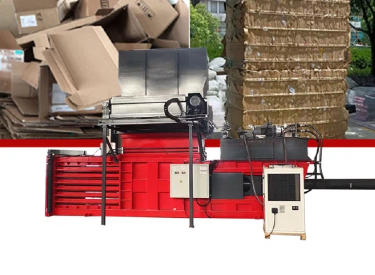
Horizontal balers are versatile and can handle a wide variety of materials:
Cardboard and Paper – Ideal for packaging facilities and printing plants. Bales are compact, uniform, and easy to transport to recycling centers.
Plastic Films and PET Bottles – Reduces the bulk of lightweight plastics, enabling efficient recycling and transport.
Textiles and Fabrics – Useful for garment manufacturers or industrial textile production, reducing waste volume and improving logistics.
Metal Scrap – Some heavy-duty horizontal balers can process thin aluminum sheets, steel cans, or other recyclable metals.
This versatility makes horizontal balers a valuable investment for companies dealing with mixed waste streams.
Conveyor belts, hoppers, and feed rollers allow continuous material loading, reducing downtime and operator intervention.
Hydraulic rams generate significant force to compress waste into dense, uniform bales. Pressure can often be adjusted depending on the material.
Automatic strapping or wire-tie systems ensure each bale is tightly secured for safe handling and transport.
Emergency stops, interlocked doors, and sensors prevent accidents. Operator safety is enhanced through machine design that minimizes direct interaction with moving parts.
Modern PLC-controlled panels monitor bale density, machine performance, and error conditions. Operators receive real-time feedback, enabling proactive maintenance and reducing downtime.
Horizontal balers streamline not just waste compression but also material logistics. Bales can be stacked efficiently in storage areas or loaded onto trucks for recycling. By standardizing bale size and weight, companies can optimize pallet arrangements, improve inventory tracking, and reduce handling costs.
Manually handling waste is labor-intensive and can lead to injuries. Horizontal balers reduce repetitive lifting, bending, and moving heavy materials. Workers spend less time managing waste and more time focusing on core production activities, improving overall workforce productivity and morale.
Recycling centers benefit immensely from pre-compacted bales produced by horizontal balers:
Simplifies sorting – Uniform bales are easier to transport and sort for different recycling streams.
Reduces contamination – Compacted waste reduces the exposure of materials to environmental contaminants.
Facilitates automated processing – Uniform bales can be fed directly into shredders, crushers, or recycling lines.
By producing recyclable bales that meet industry standards, companies contribute to circular economy practices.
Investing in a horizontal baler can lead to significant cost savings over time:
Lower waste transportation and disposal costs
Reduced labor hours dedicated to waste management
Revenue from recyclable materials
Increased operational efficiency and reduced downtime
Many industrial operators report ROI within one to two years due to these combined savings.
When selecting a horizontal baler, consider:
Material type – Cardboard, plastics, metals, textiles, or mixed waste
Bale size and weight requirements – Compatibility with storage and transport systems
Automation level – Manual vs. fully automated feed and tying
Space constraints – Machine footprint and workflow integration
Safety and compliance features – Essential for regulatory adherence and workforce protection
Consulting with reputable manufacturers ensures that you choose a system tailored to your operational needs.
Modern horizontal balers have transformed waste management in industrial settings. By automating compression, reducing labor, and creating uniform, transportable bales, they provide tangible benefits in cost savings, workplace safety, operational efficiency, and sustainability. From large-scale manufacturing plants to recycling centers, these machines are essential for businesses looking to streamline operations and optimize their waste management strategy.
If you’re looking to invest in high-quality, reliable horizontal balers, www.kinboxtools.com offers a wide range of solutions designed for industrial efficiency and durability. Their machines combine advanced automation, intelligent controls, and robust construction—helping companies achieve maximum productivity, safety, and environmental responsibility.


 English


